Introduction
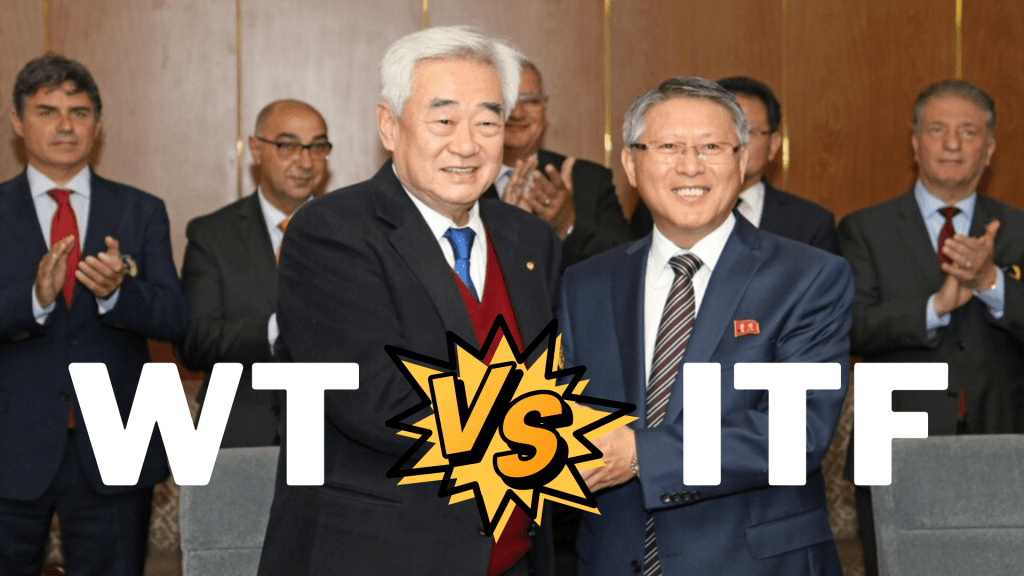
When first introduced to the sport of Taekwondo, one might come across the World Taekwondo (WT) and the International Taekwondo Federation (ITF). While both organizations seem to be affiliated with each other, they share a long history marked by a series of controversies.
Origins and Evolution
The journey of Taekwondo began with the establishment of the Korea Taekwondo Association under the leadership of Choi Hong-hee in 1959. After disagreements with other directors, the association was re-established as the Korean Tae Soo-do Association in 1961 during Choi’s overseas assignment in Malaysia. Upon his return, Choi was appointed as the third president.
The ITF, founded later by Choi in 1966, carries forward his initial goals and spirit. Initially, the Korea Taekwondo Association was responsible for promoting Taekwondo domestically, while the ITF was in charge of its international promotion.
However, political disagreements led to Choi’s exile and the subsequent creation of a new international organization, the World Taekwondo Federation (WT), independent of the Taekwondo Federation in 1973.
With government support, the WT became an official Olympic sport in 2000, surpassing ITF’s influence. Although ITF had a significant presence in former communist countries, many joined the WT after it became an Olympic sport. ITF, divided into several factions, including North Korean and non-North Korean groups after Choi’s death in 2002, is experiencing internal conflict. Despite this, it still has a large training population, and officials from both sides continue to interact, though practical issues make actual integration uncertain.
Differing Philosophies and Techniques
WT, based in South Korea, emphasizes fast, dynamic sparring and is recognized by the International Olympic Committee, paving the way for WT athletes to compete in the Olympics.
ITF uses a different sparring technique, places more emphasis on self-defense, and despite starting in South Korea, has gained popularity in countries connected to North Korea.
Geographical and Political Influence
WT, headquartered in Seoul, South Korea, has a significant presence in the country. Conversely, ITF primarily operates outside of Korea, maintains connections to North Korea (!), and has branches worldwide.
The geographical and political affiliations of the two groups have resulted in a unique situation where the governing bodies of the same sport are divided not only by their approach to Taekwondo but also by their geopolitical ties.
The Complex Modern History and Future Prospects
Due to the complex history involving Choi’s exile to Canada, his alliance with North Korea, and the subsequent establishment of WT by the Korean government, misconceptions have spread.
Despite ITF being recognized as a South Korean martial art, some perceive ITF as North Korean due to its promotion in North Korea. The story behind WT’s victory over ITF involves early members who founded Taekwondo.
One key event is the political conflict between Choi, a general in the ROK Army, and President Park Chung-hee, resulting in Choi’s exile to Canada. Choi then moved the headquarters of the ITF from Korea to Toronto, Canada, and opened ITF gyms in North America, Europe, and Japan.
The World Taekwondo Federation (WT) has also had internal turmoil amongst candidates and leaders. In 2009, during the presidential election, political interference became evident when lawmaker Hong Joon-pyo made statements that politicized the process, which ultimately favored the re-election of Cho Jung-won as president.
The leadership of WT, notably figures like Kim Un-yong, has been questioned for having limited martial arts background and for involvement in corruption. Furthermore, there are controversies over the historical portrayal of Taekwondo, with claims of inaccurately presenting it as a traditional Korean martial art derived from Taekkyeon, despite its modern origins based on Shotokan Karate.
Conclusion
Despite the controversies and divisions within the Taekwondo community, one unifying factor remains: its enduring status as an Olympic sport. While debates persist, the inclusion of Taekwondo in the Olympic Games stands as a testament to its global significance and widespread appeal.





 Taekwondo Together
Leave a comment