
At the heart of Taekwondo lies a meticulously designed belt system, symbolizing a practitioner’s progress and achievements. This article explores the significance of Taekwondo’s belt system, delving into the essence of each belt color and the milestones they represent.
In the past, Korean martial arts, including the predecessors of Taekwondo, used sashes or cloth belts to indicate rank and differentiate practitioners of various skill levels. These belts were often made of simple materials like cotton or silk and were tied around the waist.
The colors of the belts, starting from white and progressing through yellow, green, purple, blue, brown, orange, red, poom, and ultimately black, were chosen to symbolize the stages of growth and development in martial arts. Each belt color represents a specific level of skill, knowledge, and experience, with the black belt representing mastery and expertise.
Belt Colors and Their Meanings
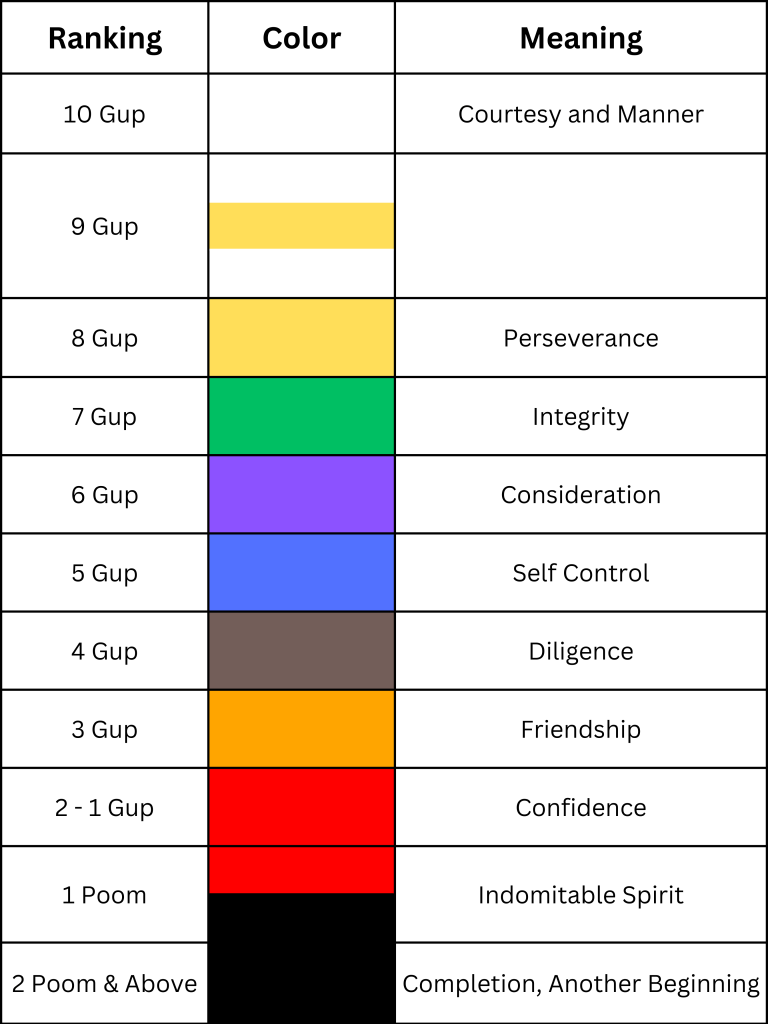
1. White Belt: The stage of learning basic posture and manners when first starting Taekwondo. White stands for ‘courtesy and respect.’ White symbolizes innocence and purity, indicating that they are in the fundamental, beginning stages of their journey. At this stage, practitioners focus on developing fundamental skills such as stances, basic strikes (punches, kicks), blocks, and simple combinations. White belts also learn basic Taekwondo etiquette and terminology.
2. White and Yello Stripe Belt: An intermediary progression from the white to the yellow belt.
3. Yellow Belt: As practitioners progress from the white belt, they transition to the yellow belt, symbolizing the initial stages of growth. The yellow belt represents the sprouting of knowledge and skills, akin to a seedling breaking through the soil. The yellow belt means ‘patience’. This is the stage of learning patience and being able to endure even difficult situations. Specifically, they learn more complex combinations, and additional strikes, and begin to practice basic sparring drills. Balance, flexibility, and coordination are emphasized during this phase.
4. Green Belt: The green belt marks a significant milestone in the Taekwondo journey. It represents progress, growth, and a deeper understanding of the art. It also means ‘shamelessness’. This is a stage where one should expect not to be proud of one’s abilities and always learn with a humble attitude. Once at the green belt, players delve into more advanced kicks, including jumping and spinning kicks. They also learn poomsae (forms) specific to their belt level, which are choreographed patterns of movements that simulate combat situations.
5. Purple Belt: You learn about consideration. You will practice techniques such as side kicks, sparring, and knife-hand block assists.
6. Blue Belt: Advancing to the blue belt level signifies the practitioner’s further exploration and expansion of their skills. The blue belt symbolizes the vastness of the sky, reflecting the practitioner’s widening horizons and the pursuit of more advanced techniques and concepts. Overall, the blue belt epitomizes the concept of ‘self-denial’. It means overcoming difficult and difficult times and refraining from getting angry due to greed and impulsive emotions through your own will. They also learn more intricate poomsae, which require precision, control, and fluidity of movement.
7. Brown Belt: The night sign means ‘justice’. It means having the right mindset by training your mind and body to follow the rules and practice justice.
8. Orange Belt: You learn about friendship. You will practice techniques such as consecutive kicking, sparring, breaking, and advanced skills.
9. Red Belt: The red belt represents a stage of passion. It signifies the practitioner’s heightened proficiency and expertise in Taekwondo. This is a stage that means to do everything passionately with all your might and to practice with a passionate attitude. At this level, practitioners focus on refining their techniques, emphasizing precision, accuracy, and the development of mental and physical discipline.
10. Poom Belt: The poom belt, which is half red and half black, means ‘undaunted and indomitable.’ It means that even if you are defeated a hundred times, you will always get back up again. It means to challenge to the end without giving in to any difficulties.
11. Black Belt: The black belt is the ultimate goal and culmination of the Taekwondo journey for many practitioners. The meaning of the black belt is ‘completion’ and at the same time, it is a stage of another beginning. It represents mastery, expertise, and “rebirth.” Attaining a black belt requires years of dedicated training, unwavering commitment, and the embodiment of Taekwondo’s principles. The black belt is further distinguished by various degrees, each denoting increased skill, experience, and leadership within the Taekwondo community.
Advancing through the belt system is typically marked by formal evaluations or tests conducted by qualified instructors or belt promotion committees.
These assessments assess the practitioner’s proficiency in various aspects of Taekwondo, including techniques, forms (poomsae), sparring, self-defense, and breaking techniques. Testing provides practitioners with an opportunity to showcase their skills, receive feedback, and set new goals for continuous improvement.






 Taekwondo Together
Leave a comment