Origin and Etymology:
The name “Taekwondo” is derived from the Korean words “Tae” (태), meaning “to strike or break with foot”; “Kwon” (권), meaning “to strike or break with fist”; and “Do” (도), meaning “way” or “art”. Hence, Taekwondo can be translated as “the way of the foot and fist”.
Historical Background:
Taekwondo’s origins can be traced back to Korea’s Three Kingdoms era (57 BC to 668 AD). During this period, there were three rival kingdoms: Goguryeo, Baekje, and Silla. Each kingdom had its own martial arts practices. For instance, Goguryeo was known for a martial art called “Subak,” and in Silla, an elite group of young nobles called the “Hwarang” practiced their own form of martial arts, which was a combination of combat techniques and mental discipline.
Modern Development:
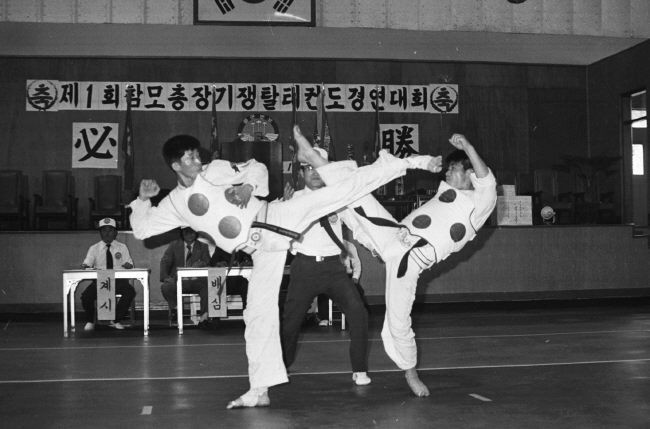
The physical techniques of Taekwondo are drawn from these ancient Korean martial arts, but the sport as we know it today began to take shape in the 1940s and 1950s. After the Japanese occupation of Korea ended in 1945, Korean martial artists who had studied in Japan opened schools (kwans) where they combined elements of Korean and Japanese martial arts. The term “Taekwondo” was officially adopted in 1955 after a push by the South Korean military and various martial artists to unify the various martial arts styles into a single style and national sport. General Choi Hong Hi played a significant role in Taekwondo’s development and international spread. He is often referred to as the “Father of Taekwondo.”
Internationalization:
Taekwondo became truly global when it was introduced to the rest of the world in the 20th century. The formation of the World Taekwondo Federation (WTF) in 1973 and Taekwondo’s introduction as a demonstration sport in the 1988 Seoul Olympic Games were pivotal in this respect. It became an official Olympic sport in the 2000 Sydney Olympic Games.





 Taekwondo Together